
The AI Reimagination Company

San Francisco, CA --:--

May 15, 2025

Share

Category /

ROI & Strategy

1 min read

Arun Raj

Software Engineering Analyst

Understanding Retrieval-Augmented Generation (RAG)

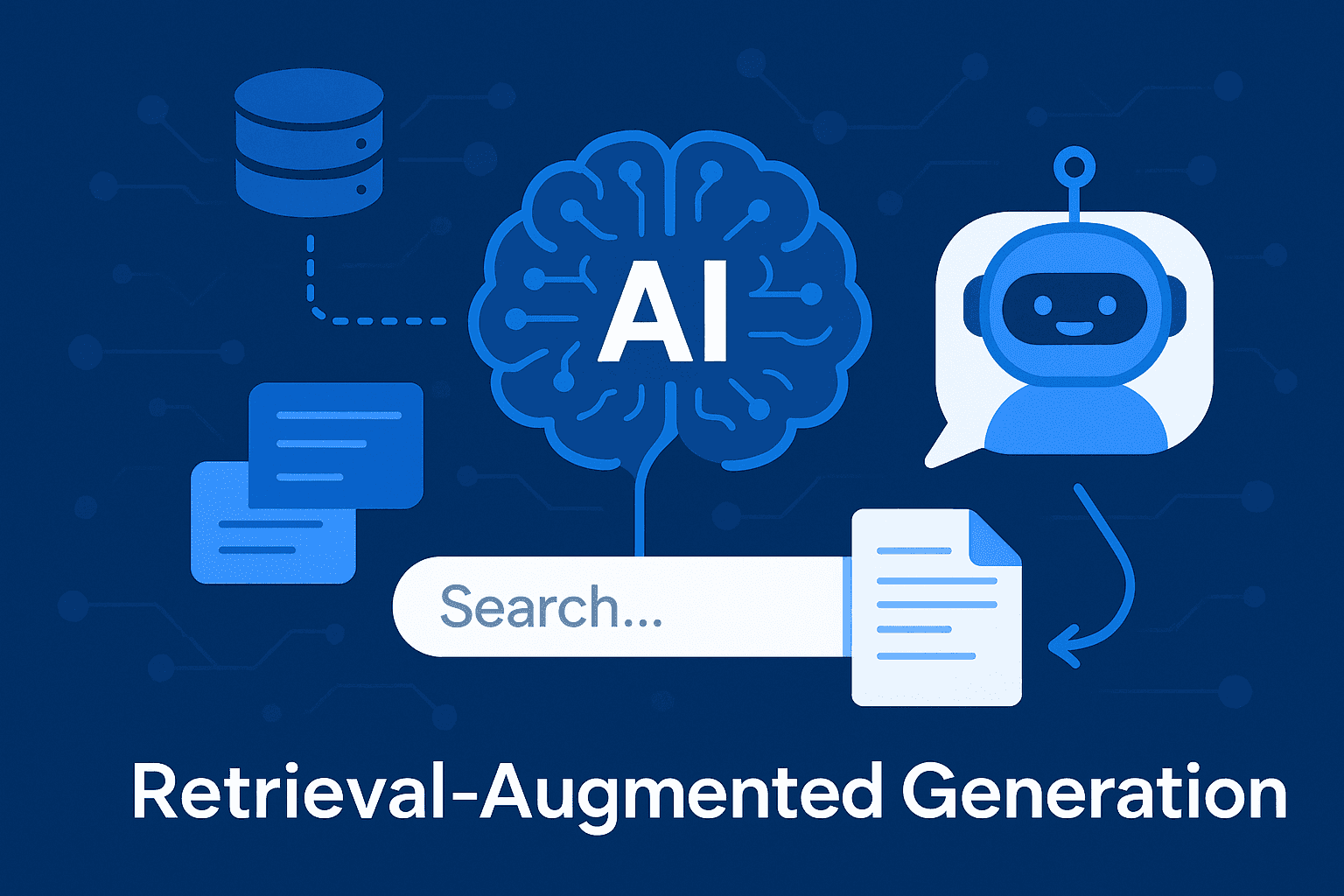
Retrieval-Augmented Generation (RAG) is an advanced AI architecture that combines two key components, a retriever to fetch relevant information from an external knowledge source and a generator (a large language model) to create human-like responses using that information.

scroll

Table of contents

Retrieval-Augmented Generation (RAG) is an advanced AI architecture that combines two key components, a retriever to fetch relevant information from an external knowledge source and a generator (a lar

Understanding Retrieval-Augmented Generation (RAG)
__wf_reserved_inherit

What is RAG?

Retrieval-Augmented Generation (RAG) is an advanced AI architecture that combines two key components:

1. A retriever to fetch relevant information from an external knowledge source.

2. A generator (a large language model) to create human-like responses using that information.

Unlike traditional language models that rely only on internal training, RAG can pull in fresh, factual data from outside sources — making it smarter, more accurate, and less prone to hallucinations.

Where is RAG Used?

RAG is ideal for any task that requires current, factual, or domain-specific information.

Examples include:

- Customer Support Chatbots

- Search Engines

- Enterprise Knowledge Assistants

- Scientific/Medical Question Answering

- Document Summarization with References

- Legal Document Analysis

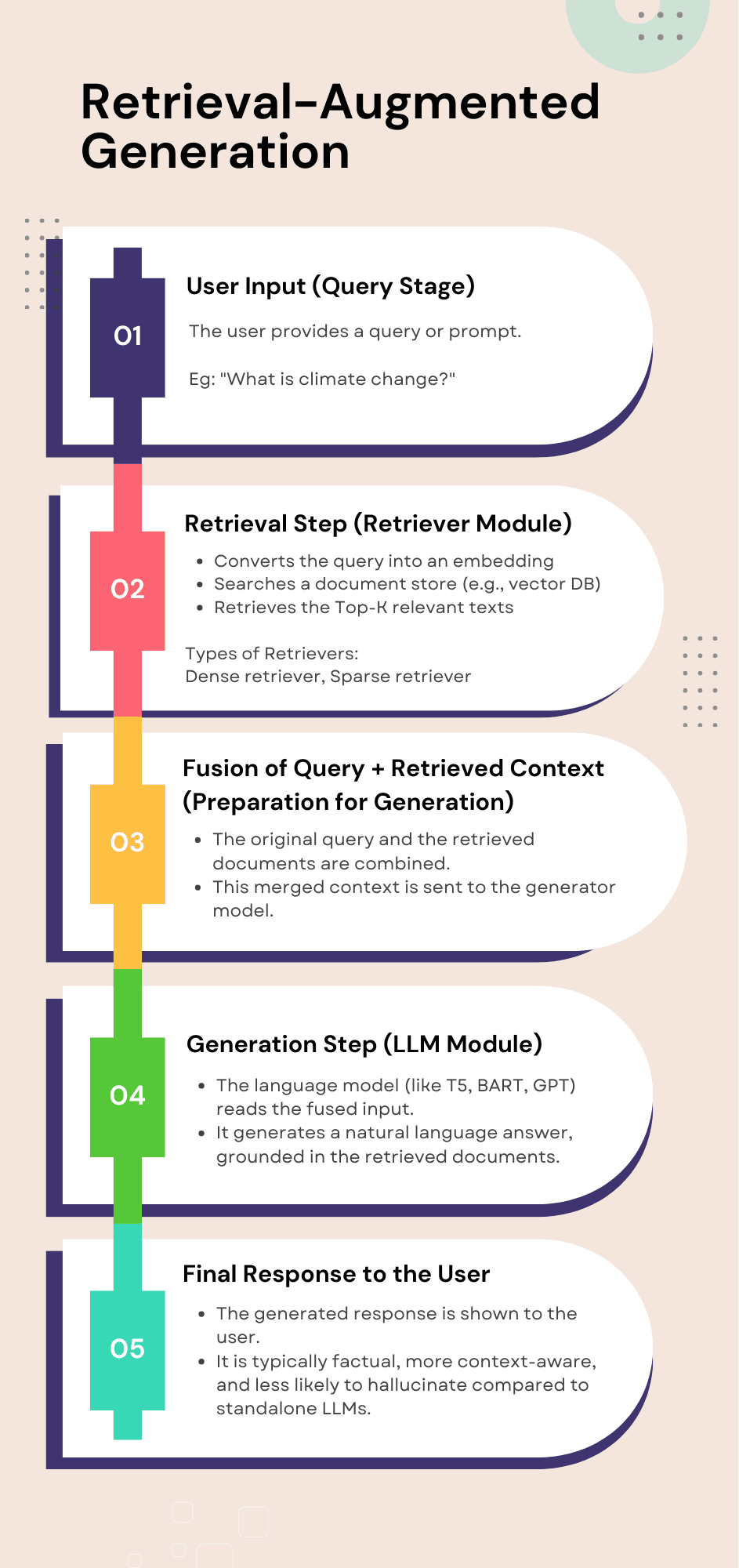
How RAG Works (Step-by-Step)

1. User Query

- User asks a question (e.g., “What causes global warming?”)

2. Retriever

- Converts the query into an embedding

- Searches a document store (e.g., vector database)

- Retrieves the Top-K relevant texts

3. Fused Input

- The system combines the original question with the retrieved texts

- Creates a new prompt with richer context

4. Generator (LLM)

- A language model (e.g., GPT, T5, BART) uses this fused input

- Generates a natural, fact-based answer

5. Final Output

- The answer is returned to the user, grounded in actual documents

Why Use RAG? (Benefits)

- Reduces hallucinations

- Allows up-to-date, dynamic knowledge injection

- More scalable than retraining LLMs

- Great for specialized, high-trust domains

Challenges

- If retrieval quality is low, output suffers

- Context length limits in LLMs

- High compute cost for large-scale implementations

[01]

AI Knowledge base

_

More Articles

More Articles

More Articles

[10]

lets get started

_

See what's possible. Book your free AI audit.

ROI projections for your business

BEST-FIT TECHNOLOGY STACK

Implementation timeline

Every engagement starts with understanding your business. We deliver outcomes, not just advice.

Book a free 30-minute audit with our team. We'll review your processes and show you exactly what's possible.

SCHEDULE A 30-MIN CALL
We'll reach out within 2 hours to schedule your call.

[10]

lets get started

_

See what's possible. Book your free AI audit.

ROI projections for your business

BEST-FIT TECHNOLOGY STACK

Implementation timeline

Every engagement starts with understanding your business. We deliver outcomes, not just advice.

Book a free 30-minute audit with our team. We'll review your processes and show you exactly what's possible.

SCHEDULE A 30-MIN CALL
We'll reach out within 2 hours to schedule your call.

[10]

lets get started

_

See what's possible. Book your free AI audit.

ROI projections for your business

BEST-FIT TECHNOLOGY STACK

Implementation timeline

Every engagement starts with understanding your business. We deliver outcomes, not just advice.

Book a free 30-minute audit with our team. We'll review your processes and show you exactly what's possible.

SCHEDULE A 30-MIN CALL
We'll reach out within 2 hours to schedule your call.