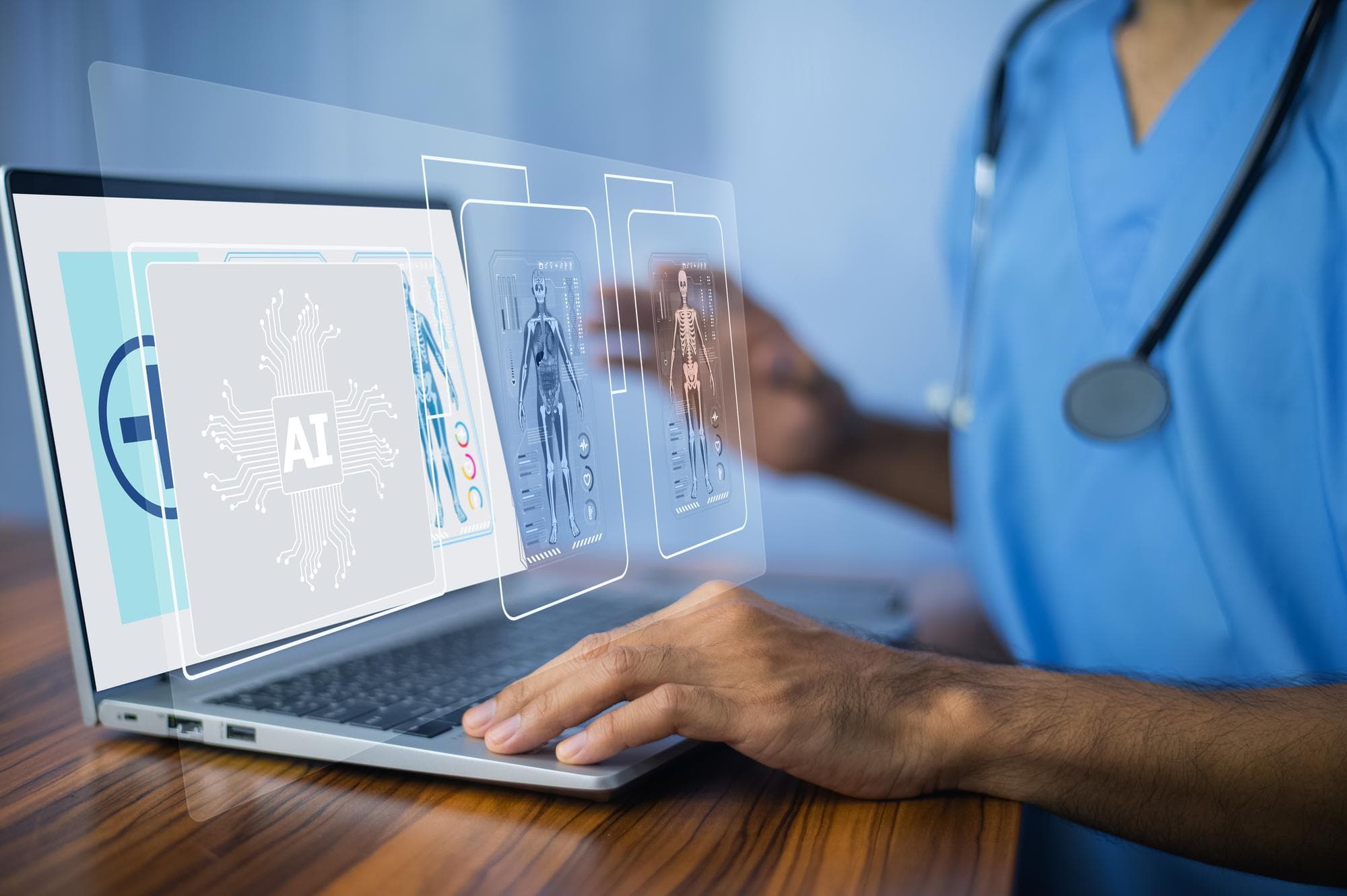
Artificial intelligence in healthcare is moving faster than almost any other application of AI in medicine right now. Hospitals are using it to read scans, flag high risk patients before they get worse, and cut down the paperwork that eats up a clinician's day. But it's not all smooth sailing. Healthcare runs on strict regulations, sensitive patient data, and decisions that can affect someone's life, so rolling out AI here takes more care than in most other industries.
This guide covers where AI in healthcare is being used today, real AI healthcare solutions in action, the challenges that come with adopting them, and a few platforms we've built at Techjays that show what this looks like in practice.
What is AI in Healthcare?
AI in healthcare, often called artificial intelligence in healthcare, means using machine learning and related technology to help with tasks that used to depend entirely on people, like reading medical images, predicting how a disease might progress, or pulling useful information out of patient records. It doesn't replace clinical judgment. It gives doctors and hospital staff a faster, more accurate starting point so they can make better decisions in less time.
Applications of AI in Healthcare
Most AI healthcare solutions today fall into three areas: reading and interpreting medical data, supporting diagnosis, and reducing the manual work involved in managing patient records.
1. AI in Medical Diagnosis and Imaging
This is where AI has made the biggest jump so far. Machine learning models, especially convolutional neural networks (CNNs), are trained on huge volumes of medical images like X-rays, CT scans, and MRIs. Once trained, they can spot patterns such as tumors or fractures with an accuracy that's now close to, and in some cases matches, trained radiologists.

The catch is that these models need consistent, well labeled data to perform well. Every hospital uses slightly different imaging equipment and labeling practices, so a model trained at one facility doesn't always translate perfectly to another. That's usually solved with domain adaptation, essentially retraining or fine-tuning the model on data from the new environment before it goes live.
AI in Electronic Health Records (EHR) and Clinical Documentation
A lot of useful medical information sits in unstructured text: doctors' notes, discharge summaries, referral letters. Natural language processing (NLP) is what lets AI actually read and make sense of that text. Language models fine-tuned specifically on medical terminology can pull out diagnoses, medications, and history from EHRs, which saves clinicians from digging through pages of notes manually.
AI in Genomics and Personalized Treatment
AI is increasingly used to analyze genetic data and spot patterns linked to hereditary conditions. Algorithms like random forests and deep learning models can process genetic sequences far faster than manual analysis, which is helping researchers identify disease risk earlier and tailor treatment plans to a patient's specific genetic profile.

Courtesy: National Cancer Institute
2. AI in Patient Management: Elevating Personalized and Predictive Care
Beyond diagnosis, AI healthcare solutions are changing how hospitals manage patients day to day, from predicting who's at risk to freeing up staff time on routine tasks.

Courtesy: DataAspirant
Predictive Analytics in Healthcare: Predictive analytics uses a patient's history and real time data to forecast how their condition might progress. For conditions like sepsis or heart failure, models built on gradient boosting or deep reinforcement learning can flag warning signs early enough for clinicians to act before a situation becomes critical. Wearable devices add another layer here, feeding continuous data that models use to track chronic conditions and trigger alerts when something looks off.

Courtesy: Revealalbi.io
AI Health Chatbots and Virtual Assistants
These tools are built for routine work: answering common questions, helping patients book appointments, and handling simple triage. They're trained on large volumes of medical literature so they can hold a conversation in a clinical context without sounding generic. They're not meant to replace a doctor's judgment, and the good ones make that clear to the patient.

Courtesy: Revechat
AI in Telemedicine and Triage
AI handles a lot of the administrative load in telemedicine: transcribing consultations automatically using speech to text, and triaging patients by analyzing their reported symptoms against models like Bayesian networks to figure out how urgently they need to be seen. This is one of the areas where AI saves the most staff time without touching the actual clinical decision.
3. AI in Clinical Workflows
Interoperability with existing healthcare systems is a constant theme once AI moves from a pilot into an actual clinical environment. Getting a model to perform well in a lab is one thing. Getting it to work inside a hospital's daily workflow, alongside every other system already in place, is what determines whether it actually gets used.

Courtesy: Noorul Athar
Fast Healthcare Interoperability Resources (FHIR) standards facilitate data exchange between AI and EHR systems. However, in a practical scenario, real-time data processing can show latency. This can be addressed using high-throughput, low-latency data architectures.
Edge Computing in Healthcare: Edge computing is essential in healthcare to manage the volume and velocity of incoming data. In edge computing, data is processed closer to its source, thus reducing latency and enhancing response times. This is especially important for critical applications like patient monitoring in intensive care units.

Courtesy: CBInsights
Federated Learning in Healthcare AI
Federated learning is a decentralized machine learning approach that trains AI models across multiple hospitals without moving or exposing their sensitive data. Instead of pooling patient data into one place, the model travels to each hospital's data, learns from it locally, and only shares the learned updates back. Techniques like differential privacy and secure multiparty computation are used alongside this to keep patient data private throughout the process, which makes it easier for multiple healthcare systems to collaborate on a shared model without any single one giving up control of its data.
Challenges of Implementing AI in Healthcare
The technology works. The harder part is making it safe, fair, and usable inside a real hospital system.
Data Security and HIPAA Compliance
Patient data is some of the most sensitive data that exists, and any AI system touching it needs to meet HIPAA requirements, which means strong encryption, strict access controls, and audit trails on who accessed what and when. This isn't something you bolt on later. It has to be part of the architecture from the start.
Bias and Fairness in Healthcare AI
If a model is trained on data that underrepresents certain groups, it can end up making less accurate predictions for those patients, which widens existing healthcare disparities instead of closing them. Techniques like model fairness optimization and adversarial debiasing help reduce this, but they require deliberate effort during model development, not just good intentions.
Calibration and Uncertainty: Knowing When to Trust the Model
AI models in healthcare output risk scores, but high accuracy alone doesn't make those scores reliable. Calibration ensures that a predicted 80% risk means the condition occurs in roughly 80% of such patients, which is critical when scores drive alerts, triage and treatment decisions.
Recalibration techniques: Temperature scaling, Platt scaling and isotonic regression correct the overconfidence common in CNNs and gradient-boosted models.
Measurement: Reliability diagrams and Expected Calibration Error (ECE) should be reported alongside AUC.
Fairness: Checking calibration across patient subgroups shows whether risk is consistently over- or under-estimated for specific populations.
Uncertainty estimation: Deep ensembles and conformal prediction flag low-confidence cases for clinician review, which makes human oversight practical.
Challenges: Calibration drifts when models move to new hospitals, devices or populations, so it needs local recalibration and continuous monitoring as part of FDA-aligned performance tracking.
Is AI Going to Replace Doctors?
No, and this comes up in almost every conversation about AI in medicine. AI is good at pattern recognition across huge datasets, which makes it useful for tasks like reading scans or flagging risk. What it can't do is take responsibility for a clinical decision, understand a patient's full context the way a doctor can, or handle the judgment calls that come up in messy real world cases. The realistic outcome is AI handling more of the repetitive analytical work while doctors focus on decisions and patient relationships, not AI replacing doctors outright.
Ethical Considerations in AI in Medicine
Two questions come up again and again: can we trust the AI's recommendation, and who's responsible if it gets something wrong?
On trust, the push is toward explainable AI (XAI), using techniques like SHAP and LIME to show clinicians why a model reached a particular conclusion instead of just handing them a black box answer. On responsibility, giving AI more autonomy in clinical decisions raises real liability questions, which is why most AI healthcare solutions today are designed to support a human decision, not replace it. Clear guidelines on human oversight are still catching up to how fast the technology is moving.
Real-World AI in Healthcare Examples
Here's what AI healthcare solutions look like when they're actually built and used, not just discussed in theory.
PepCare: Streamlining Patient-Doctor Communication
Pepcare came to Techjays needing a platform that would make it easier for dental practitioners to collaborate, refer patients, and communicate securely. We built a HIPAA secure platform that digitizes every part of that process, from referrals to medical record sharing.

The platform gives doctors a space to form groups, discuss cases, and pull in specialist expertise when needed. For patients, we built a feature called the Patient Vault that stores all their medical records, prescriptions, and reports in one place so nothing gets lost. Doctors can also use built in screen recording to walk patients through things like X-rays, and patients can search for doctors and check ratings before booking. Techjays is now building an AI powered version of PepCare to take this further.
Aidendo - Bolstering Endocrinology
The Advanced Institute for Diabetes and Endocrinology asked Techjays to build a platform focused specifically on endocrinology patients, tracking metrics like blood pressure, weight, and blood sugar over time.
We built an interface that syncs data from a physical monitoring device straight to the patient's phone, then into a dashboard endocrinologists can use to track progress. The platform handles everything from prescriptions to automatic alerts when a patient's metrics move outside a safe range, and it's now being built out with AI powered capabilities.

The Future of AI in Healthcare
AI's potential in healthcare, across diagnostics, patient management, and personalized treatment, is real and already showing results. But getting there means solving for data security, bias, and regulatory compliance at the same time as building the technology itself. The healthcare organizations that get the most out of AI won't be the ones that move fastest. They'll be the ones that build it right the first time, with AI developers, clinicians, and regulators working together from the start.