
Running AI got cheaper again, unless you picked the wrong supplier
The AI Pulse
Running AI got cheaper again, unless you picked the wrong supplier
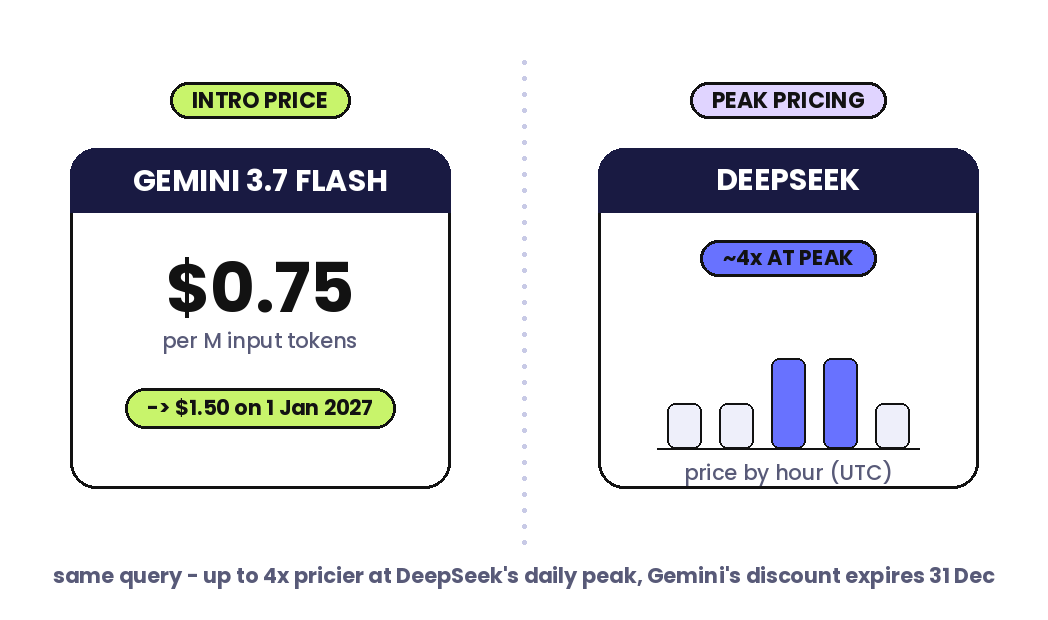
Google and DeepSeek just moved AI pricing in opposite directions. Google's new Gemini 3.7 Flash launched at an introductory $0.75 per million input tokens - a steep discount that quietly doubles on January 1, so today's price is a promotion, not a trend. DeepSeek went the other way: it now charges peak-hour rates that push output costs up to roughly 4-5x higher for anyone who doesn't plan around it.
What This Means for You
Check which of your AI costs are sitting on a promotional rate right now, and budget for the higher price once it reverts. If you're on DeepSeek, expect a real increase - shifting work off peak hours softens it, it doesn't undo it.
Source: Google · DeepSeek pricing
AT&T cut its AI coding costs 56% by routing work to cheaper models
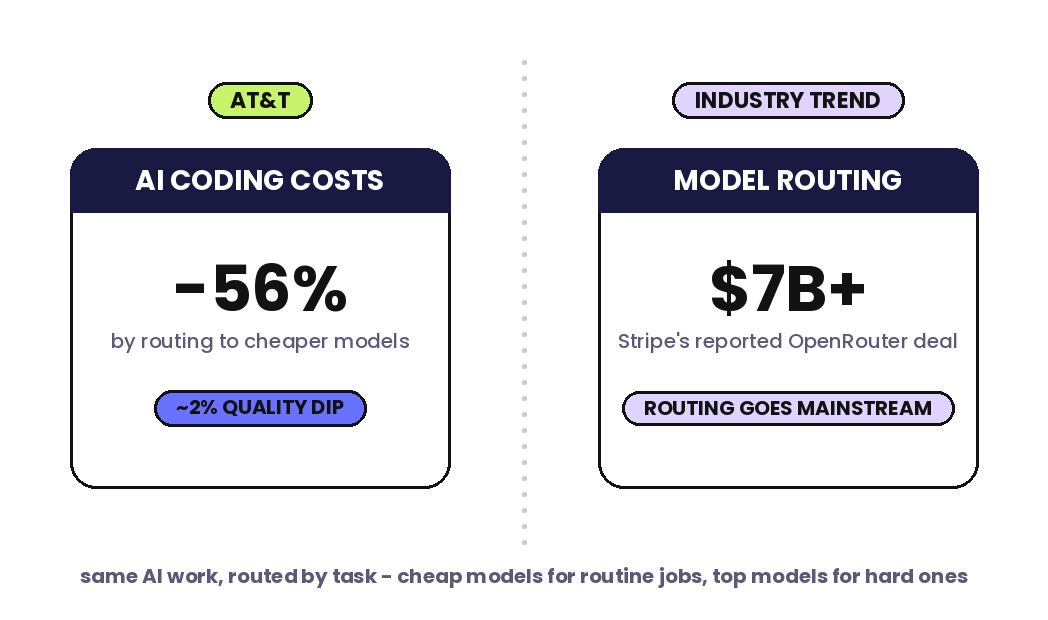
AT&T reportedly cut AI coding costs 56%, with only a 2% dip in output quality, by routing more employee queries to cheaper, often open-source models instead of sending everything to a frontier model by default (The Information, 20 August). A router scores each task for complexity first, then sends routine work to a lower-cost model and reserves premium models like Claude and GPT for the work that actually needs them.
Routing is quickly becoming standard infrastructure. Stripe has agreed to acquire OpenRouter, which already routes tokens across 400+ models for customers including Nvidia and Zoom, saying the deal will help businesses “route their requests intelligently and spend their tokens efficiently” (terms undisclosed; reportedly valued above $7 billion). Days later, Ramp launched its own router, offering free access through the rest of 2026 and reporting a 30% cut to its own AI bill.
What This Means for You
Not every request needs your most expensive model. A routing layer - even a simple one - can send routine work to a cheaper model and save the frontier model for what actually needs it. AT&T held quality within 2% while cutting spend by more than half.
Source: The Information · Stripe · Ramp
Undisclosed AI chatbots can now cost €15 million in the EU
The AI Act's Article 50 transparency rules have applied since 2 August, enforced by each EU member state's own market-surveillance authority - so you can be challenged in any country your system reaches. Fines run up to €15 million or 3% of global turnover, whichever is higher (lower for SMEs and start-ups). The scope is narrower than headlines suggest: if your system talks to people, it must disclose it's AI; synthetic audio, images, video or text need a machine-readable label. What triggers it is not where your company is based, but whether the output reaches someone in the EU.
What This Means for You
If a support chatbot, AI content pipeline, or image generator you run can reach any EU user, the obligation applies today. Ten-minute check: open your own chatbot and see what it says about itself first. Most say nothing.
Source: European Commission — Article 50 FAQ · Goodwin
One Problem We Solved
Checking a thousand-page spec reduced from hours to minutes
A mechanical contractor’s engineers hand-checked every vendor cut sheet against a thousand-page spec. Each check took hours, reviewers often disagreed, and a wrong pass surfaced later as a far costlier RFI or change order.
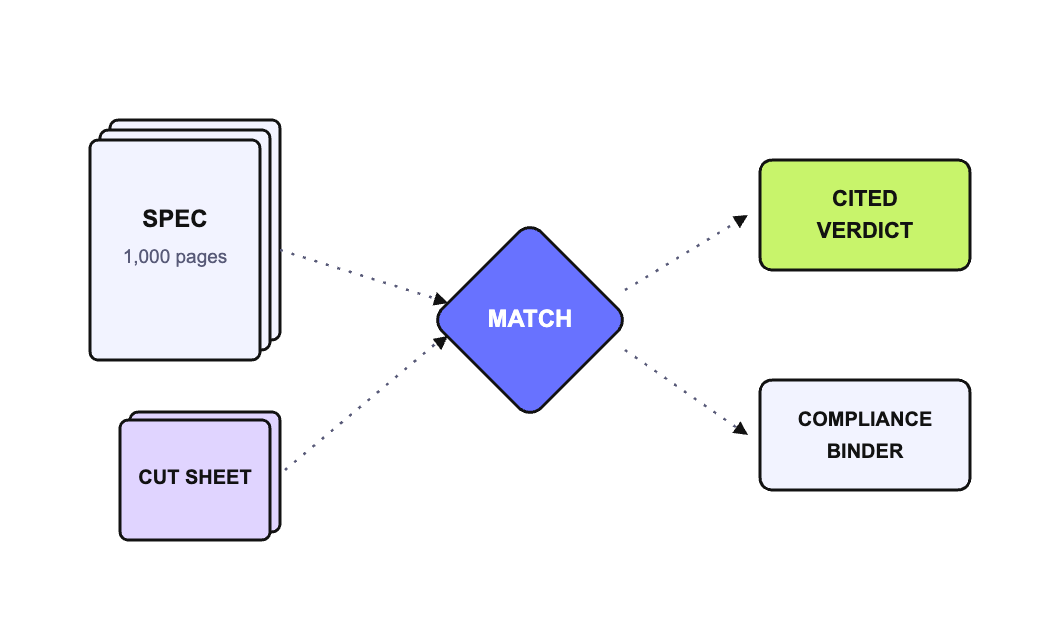
Step one. Pull requirements straight out of the spec. Step two. Pull what the vendor actually proposed off the cut sheet. Step three. Match the two and return a cited verdict, before a person signs off.
What Changed
Reviewers check cited findings instead of building them from scratch. Fewer submittals need a second pass, every verdict has a paper trail, and capacity no longer caps out with headcount.
The transferable bit. The bottleneck was never judgment - it was finding two facts to compare across a thousand pages. Automate that, and expert time goes to the calls only a person should make.
A Peek Into How We Work
Every build now gets a second, independent AI review
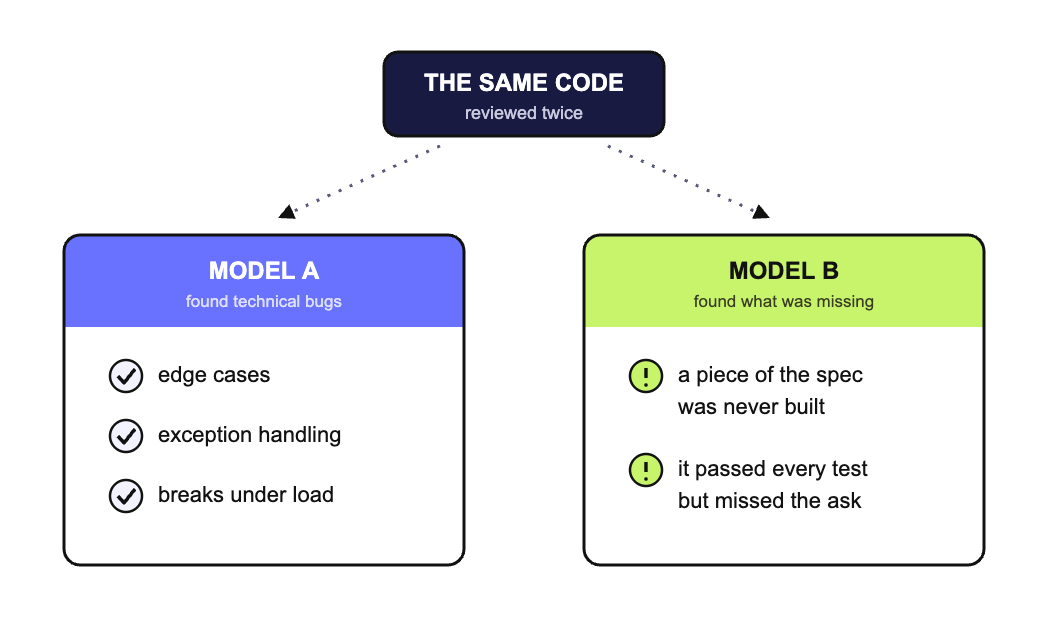
We now run every internal build past two independent AI reviewers instead of one: a different model, reviewing from scratch, with no sight of the first review. It is a deliberate second opinion, not a rerun of the same check.
The two reviewers rarely catch the same things. One tends to read for implementation - edge cases, error handling, load limits. The other reads for intent - whether what got built actually matches what was asked for. On one build, that second read caught a requirement the tests never could have: the tests had been written against what got built, so they could only confirm it worked, not that it was the right thing to build.
"One reviewer flagged the technical implementation problems. The other flagged the product ones - do you even need this, isn't this over-engineered." — From our weekly engineering sync
Tests check whether something works; they don’t check whether it’s what was asked for. A second, independent review closes that gap - which is why it’s now standard on every build we ship this quarter, and we’re tracking how often it earns its keep.
Why It Matters to You
Ask anyone building software for you, us included: is the review independent of the build, or is it the same team checking its own work? Tests confirm the build does what it does; an independent, blind review checks whether that is the right thing to have built - and it catches a different class of issue than tests alone ever will.
Trivia: One Number Worth Knowing
How many years did it take AI to out-adopt the PC and the internet?
Guess before you scroll past the picture.
The Answer
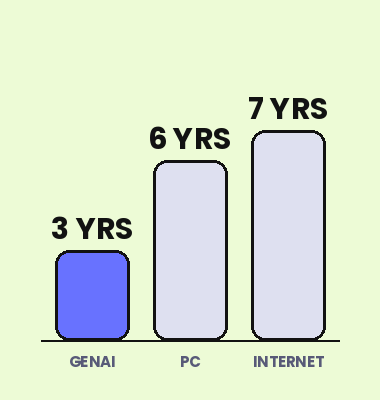
Three years. Generative AI reached 53% global adoption within three years of ChatGPT’s November 2022 launch - versus roughly six years for the personal computer and seven for the internet to reach comparable adoption (Stanford HAI, AI Index Report 2026). Adoption is outrunning almost every technology that came before it.
Source: Stanford HAI, AI Index Report 2026
A problem you want solved, or a trend you want to try? Reply and I will send a one-page view of how it would work for you. No deck, no meeting.
Philip Samuelraj
Founder and CEO