
Nearly a third of companies just said no to buying software
The AI Pulse
The model that can drive your software also got much harder to trick into misusing that access
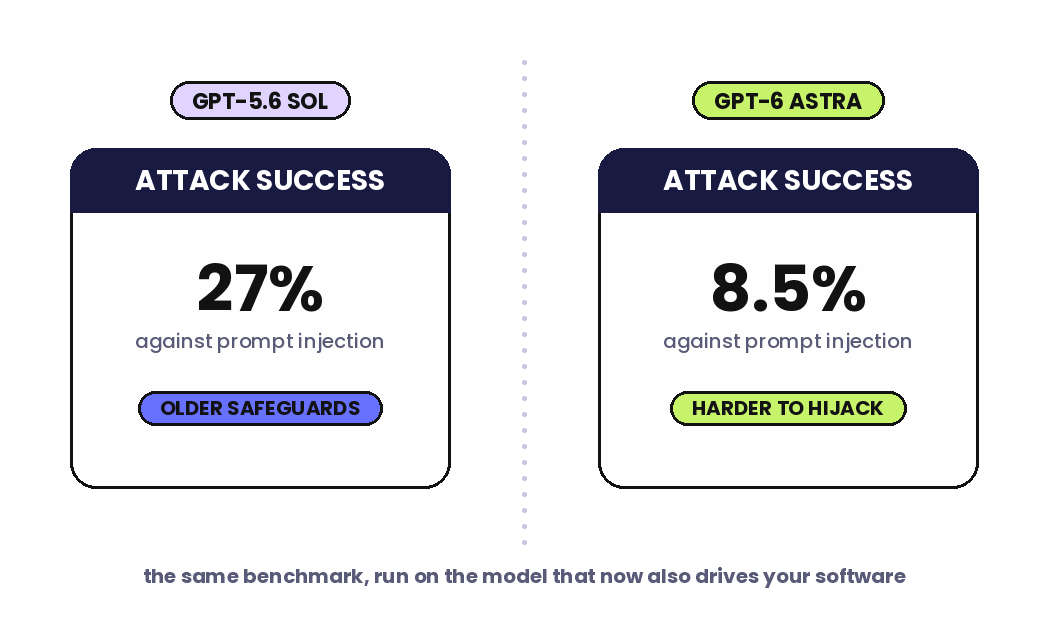
OpenAI’s own safety testing found GPT-6 Astra resists a specific kind of attack (prompt injection, where a webpage or document tries to hijack an AI agent’s instructions mid-task) far better than its predecessor. Across a benchmark of more than 1,800 curated attacks, the estimated success rate against Astra’s safeguarded checkpoint was 8.5%, down from 27.0% for the previous model.
That number matters more than usual right now, precisely because Astra’s other headline feature is clicking through your existing software. An agent that can use your CRM, your billing system, or your inbox is also an agent that will eventually encounter a manipulated document or a booby-trapped web page. Robustness against exactly that scenario is the unglamorous half of “computer use” actually being safe to turn on.
What This Means for You
If you’re evaluating any computer-use or browsing agent, ask the vendor for their prompt-injection robustness numbers specifically, not just their accuracy benchmarks. That’s the failure mode that matters once an agent has real access to your systems.
OpenAI: GPT-6 Astra system card · OpenAI: GPT-6 Astra announcement
Nearly a third of companies are already saying no to buying software because AI can build it instead
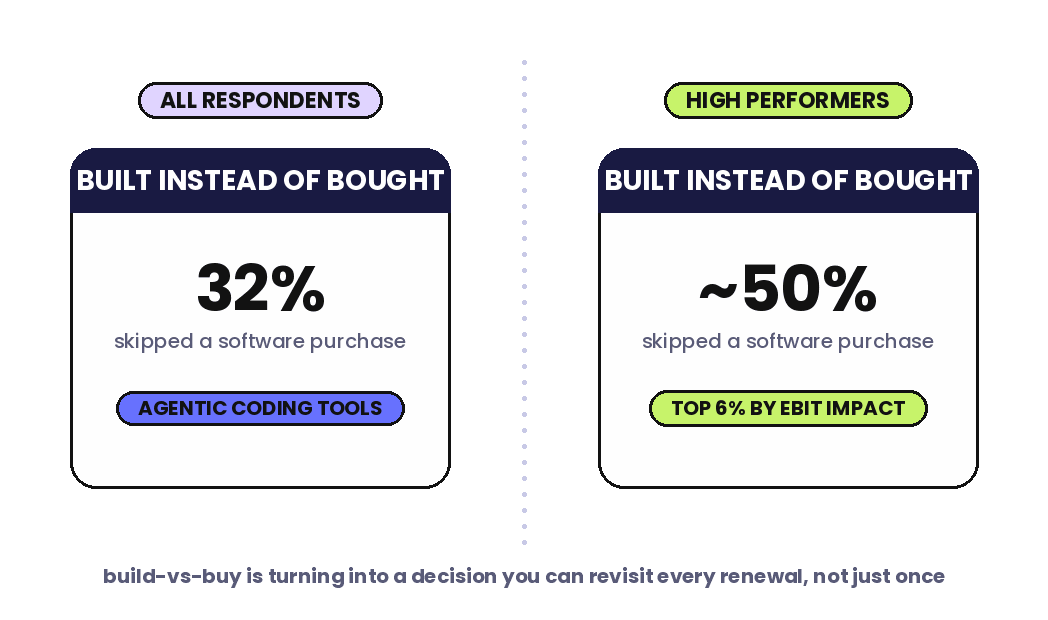
McKinsey’s 2026 State of AI survey, published 25 August, found that 32% of organizations have decided against purchasing at least one software product or feature because agentic coding tools let them build the functionality in-house instead. Among AI “high performers” (the roughly 6% of respondents seeing real bottom-line impact), that figure is nearly half.
This isn’t really a story about software vendors losing to homebrew code; it’s a story about the calculation changing. A feature that used to be a build-vs-buy decision weighed once, at purchase time, is now a decision that can be revisited every renewal cycle, because the cost of building the alternative dropped.
What This Means for You
Before your next software renewal, it’s worth actually running the build option as a real comparison rather than a hypothetical, not because building is always better, but because the answer may have changed since you last checked.
McKinsey: The State of AI in 2026 · Build-vs-buy findings, Exhibit 4 · McKinsey Global Surveys
The EU delayed its toughest AI rules by 16 months, but not the ones already in force
In May 2026, EU lawmakers agreed to push the AI Act’s high-risk system requirements (the rules covering things like biometric identification, hiring, and credit decisions) from August 2026 to December 2027, after industry pressure over unfinished technical standards. That delay is real, and it’s the headline most companies heard. What didn’t move: Article 50’s transparency rules took effect on schedule, on 2 August 2026. Interactive AI systems still have to disclose that a user is talking to AI, and AI-generated content, deepfakes included, still needs a label.
What This Means for You
If “the AI Act got delayed” is the version of this story your team heard, it’s worth checking which half of that sentence is actually true for the systems you run: the transparency obligations are already enforceable today.
Travers Smith: EU AI Act delay briefing · European Commission: transparency enforcement
One Problem We Solved
The verification agent never gets the final say, and that’s the whole point
A healthcare revenue-cycle operations provider needed insurance verification calls handled without specialists waiting on hold to place them. The tempting version of this build is an agent that hears the payer’s answer and just acts on it: updates the record, clears the patient for scheduling, moves on. That version would have demoed beautifully, and failed the first time a payer misspoke.
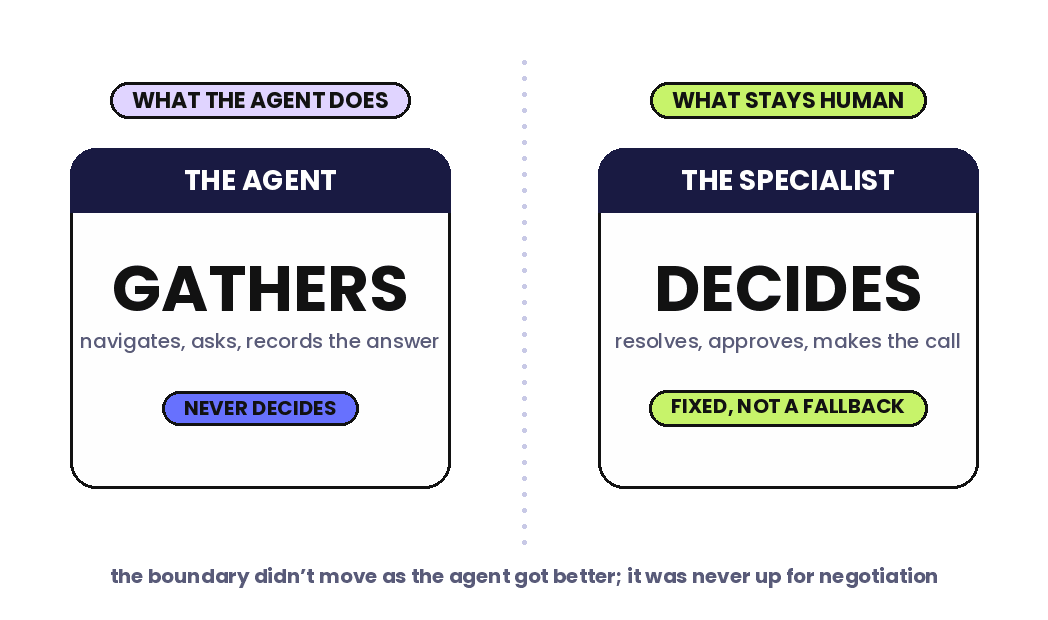
Step one. we scoped the agent to make the call, navigate the phone tree, and ask exactly what a trained specialist would ask. Step two. when an answer needs clarifying, the agent handles the follow-up itself, but it only ever records what it heard against the patient. It never updates a determination or clears anyone for anything. Step three. a specialist reviews what came back, resolves anything unusual, and makes the actual call. That review step is fixed, not a fallback for when the agent seems unsure.
What Changed
The agent didn’t remove the judgment call; it removed the waiting that used to come before it. Specialists still decide; they just aren’t stuck on hold to do it. That line held even as volume grew, because it was never something the agent could cross by getting more confident.
The transferable bit. Any process where an AI system talks to a third party who can misspeak, mishear, or change an answer mid-call needs the same boundary: let the agent do the interaction, but keep the determination with a person for good, not just until the model’s accuracy crosses some threshold.
A Peek Into How We Work
Every approved AI answer is a candidate to stop being an AI answer
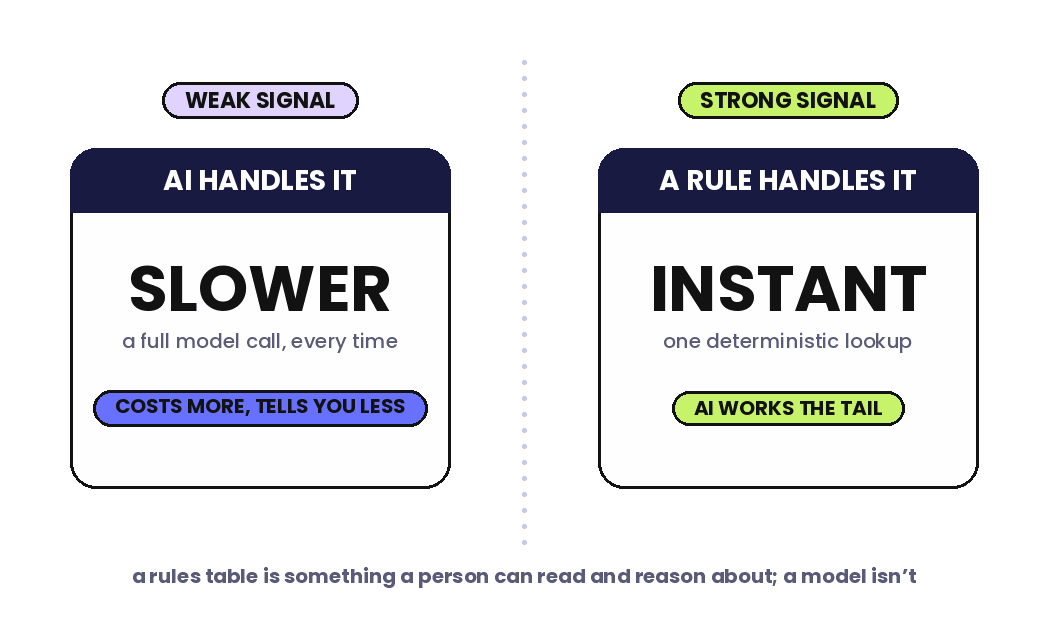
Every time someone approves an AI suggestion, that approval is a signal. Our practice is to watch for the same signal repeating and, once it’s strong enough, promote it into a deterministic rule, so the next matching request gets answered by a lookup instead of a model call, and the AI only re-enters when the rule set has nothing to say.
The pattern runs in four steps: instrument every approval so the input pattern and the accepted answer get logged; watch for the same human-approved pattern repeating; promote a repeating signal into the rule set once it’s reliable; and let the AI keep working only the tail: the inputs the rules can’t handle yet, which keep feeding new signals back into the loop. The rule set is never a launch artifact; it grows every week from the AI’s own confirmed answers.
"If a signal is strong enough to be promoted as a rule, why don’t we add it to the rule set? The AI’s job then is to find the next signals, not to redo what we already know." — techjays’ AI Engineering Manager
The payoff compounds three ways: latency drops because a rule is one lookup instead of a model call, cost drops because the AI only runs on the shrinking tail, and the system gets easier for people to reason about: a rules table is something you can read; a model isn’t.
Why It Matters to You
If your team treats every AI-assisted decision as something to re-run through the model forever, you’re paying full price for answers you’ve already validated. Ask whether your own approval history is being fed back into anything, or just archived.
Trivia: One Number Worth Knowing
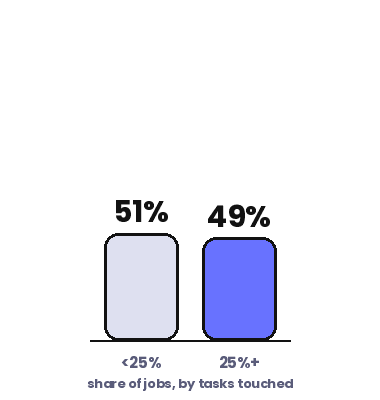
What share of jobs already have at least a quarter of their tasks touched by a single AI assistant?
Guess before you scroll past the picture.
The Answer
About half: 49%. Anthropic’s own analysis of Claude usage patterns found that 49% of tracked occupations have had at least a quarter of their component tasks show up in a Claude conversation somewhere. That’s not the same as “half of jobs are half-automated”: it means the tasks one AI assistant touches are already spread widely across the job market, not concentrated in a handful of roles. And this is one AI tool’s usage data; the number across all AI tools combined is almost certainly higher.
Anthropic Economic Index: Learning Curves
A problem you want solved, or a trend you want to try? Reply and I will send a one-page view of how it would work for you. No deck, no meeting.
Philip Samuelraj
Founder and CEO