
A new AI model works for pennies, if you're asking it the right kind of question
The AI Pulse
A new class of AI model works for pennies, if you’re asking it the right kind of question
TypeSafe, founded by an OpenAI researcher who helped build the techniques behind ChatGPT, released a model this month built to return a decision, not a paragraph. Feed Jev a structured question — fraud or not, escalate or don’t, which of a thousand records needs action — and it returns a typed answer plus a confidence score in a fraction of a second.
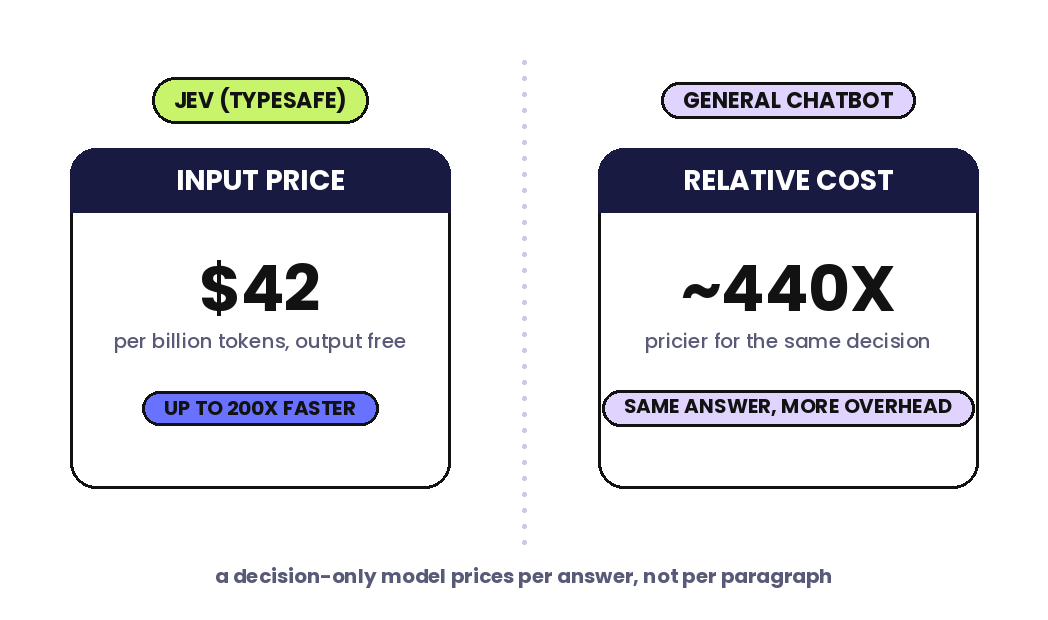
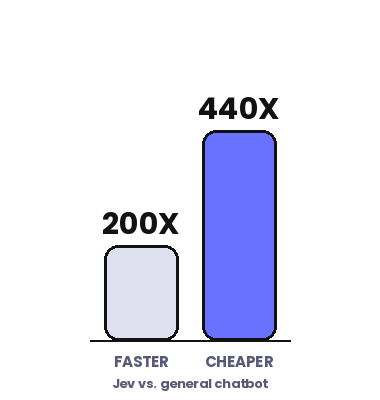
TypeSafe prices it at $42 per billion input tokens, with output free, and its own benchmarks put Jev at up to roughly 200 times faster and up to about 440 times cheaper than running the same volume of decisions through a general-purpose chatbot.
What This Means for You
Most AI workflows still use one model for everything — reading the request, making the call, and explaining itself back to a person. That’s expensive machinery for a question that only needed a yes, a no, or a score. Before you scale an AI workflow, split out the decisions that genuinely need judgment and explanation from the ones that just need an answer, and price the two differently. We wrote about why this kind of purpose-built AI has gotten so much cheaper to stand up: The Art of the Possible: Why Custom AI Is Suddenly Affordable for Every Business.
1,393 AI agents rewrote a million lines of code in 19 hours for $25,000, and a human still had to check the work
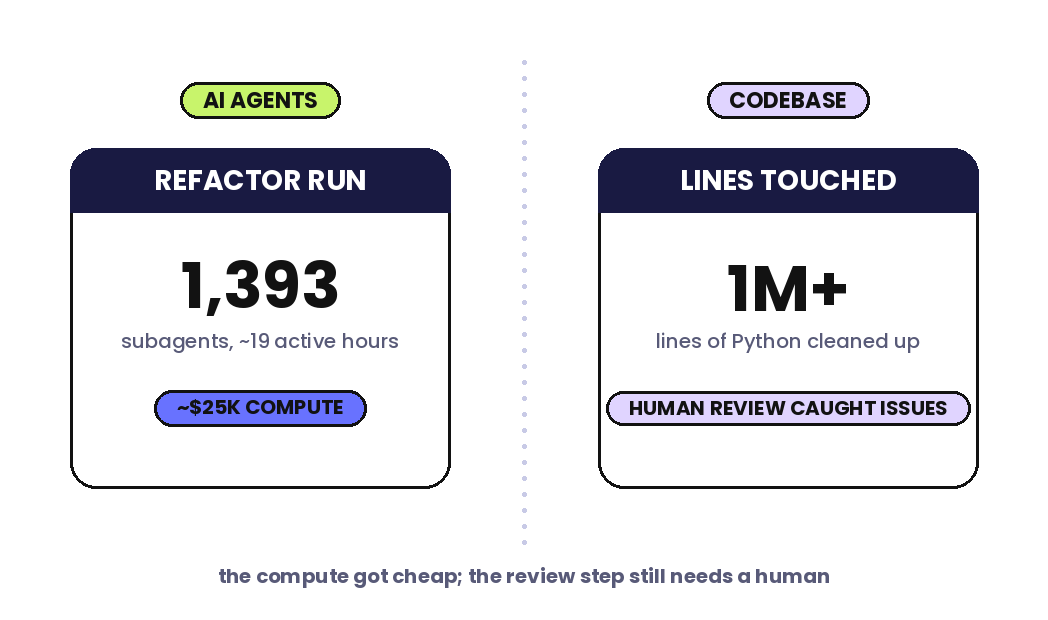
Nous Research pointed 1,393 subagents at refactoring a million-line Python codebase (cleaning up code without changing what it does), reaching 218 running at once. The main run finished in about 19 active hours for roughly $25,000 in compute.
Human and community review of the output still caught real issues — deleted names that external plugins relied on, and an automated exception-handling change that rippled out to dozens of locations — with fixes going through multiple rounds of review after the run.
What This Means for You
The economics of throwing more AI at a job keep improving, but the review step doesn’t get cheaper at the same rate, and it doesn’t disappear. Price both into any AI-heavy project — the compute is usually the smaller number.
AI saves scientists nearly 7 hours a week — most of it goes straight back into research
A Google DeepMind study analyzed roughly 360,000 science-related Gemini interactions and more than 2,600 specialized AI models, and surveyed over 600 working scientists. It found AI-assisted researchers save close to 7 hours a week on average, and most reinvest that time into more research rather than banking it.
What This Means for You
The honest caveat: most of those researchers also spend real time checking what the AI produced — 89% spend more than a tenth of their saved time verifying outputs, and nearly half spend more than a quarter. Time an AI workflow saves is usually real, but plan for a verification line item alongside it, since the check tends to land on a different desk than the one that banked the time.
Google DeepMind, "AI in Science: Early Insights"
One Problem We Solved
A machinery question now gets answered in under two minutes, not half a day
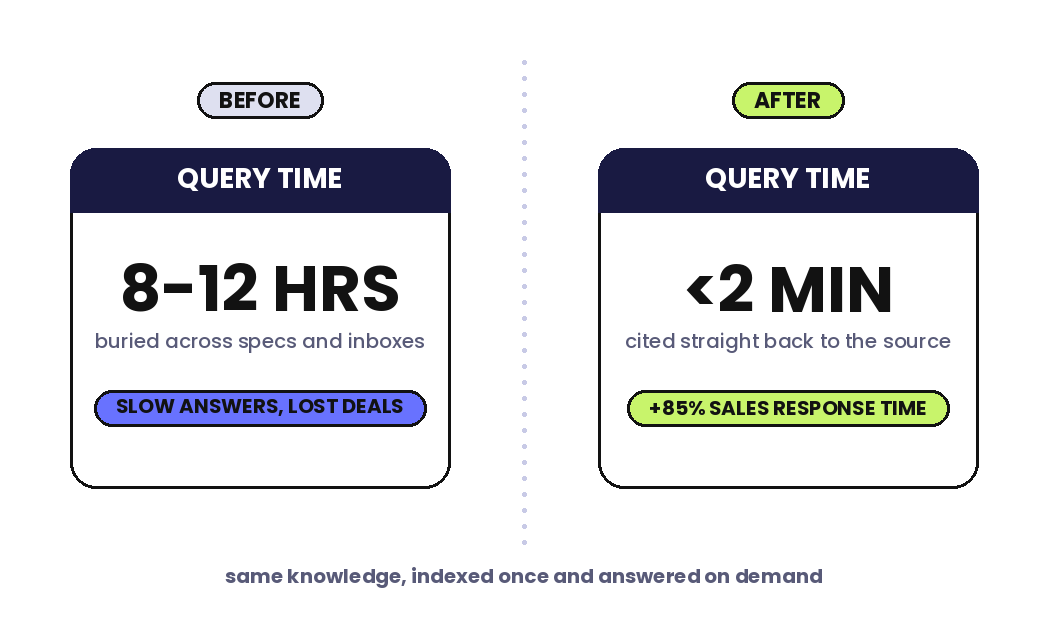
A heavy machinery company’s sales reps, engineers, and customers were burning hours on questions that had one right answer — a torque rating, a clearance, a compatible part. It just took hours to find it, buried across brochures, spec sheets, and years of email threads. Every hour spent searching was an hour a competitor could close the deal first.
Step one. Index the company’s full knowledge base — brochures, data sheets, and the expertise sitting in old expert emails — into one place. Step two. Answer in seconds, with a citation back to the source, not just a guess. Step three. When the internal knowledge base comes up short, draw on foundational industry knowledge so the question still gets answered, clearly labeled as such.
What Changed
Query times dropped from 8–12 hours down to under two minutes. Sales response time improved 85%.
The transferable bit. The real cost was never the missing answer. It was the gap between the question and the answer, multiplied by how often that gap opens in a day. Close the gap, and slow answers stop being the reason deals slip. More on how this plays out across the shop floor: How AI Is Reshaping the Manufacturing Floor.
A Peek Into How We Work
Every AI idea gets plotted on the same two-axis grid before it gets built
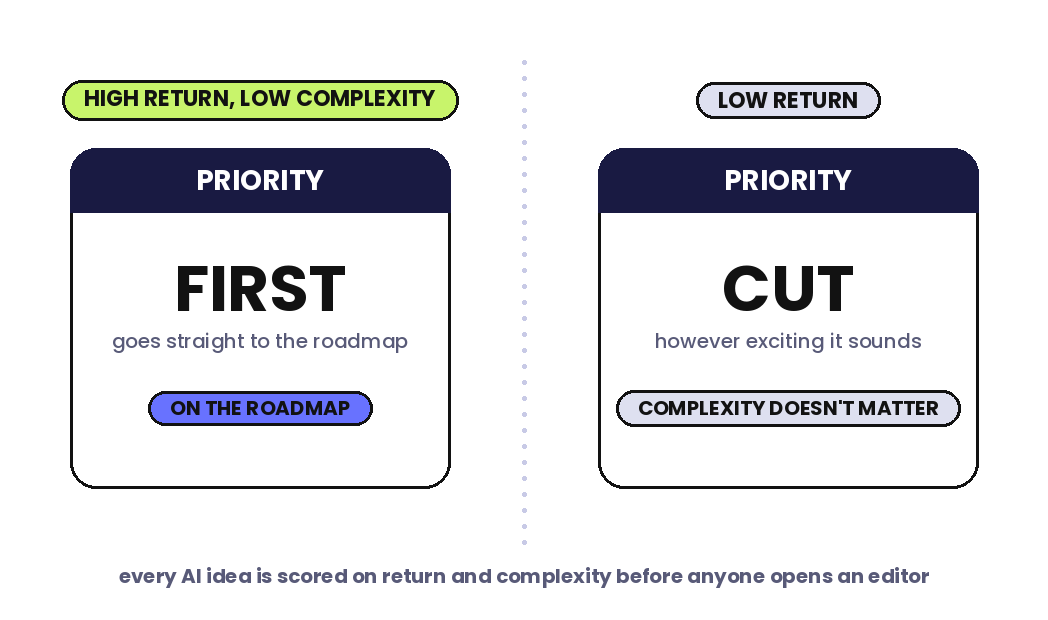
Discovery doesn’t start with a list of what AI could do. It starts with two questions, asked about every candidate workflow: how much return could this realistically create, and how hard is it actually to build. Those two answers place the idea on a simple grid. High return, low complexity goes first. High return, high complexity goes on the roadmap. Anything low return, regardless of complexity, waits or gets dropped, no matter how interesting it sounds in the room.
The grid isn’t a formality run after the fact to justify a decision already made. It’s the decision. A workflow that would be genuinely impressive to automate but doesn’t move a real number gets set aside in favor of a duller one that does, because the goal was never “what can AI do here.” It was where the return actually is.
That’s the discipline behind it: say no to more ideas than you say yes to, so the ones that get built are the ones actually worth building.
Why It Matters to You
If your own AI conversations start with “what could we build,” add the second half of the question before anyone opens an editor: what’s the return on building it, and how does that compare with the next three ideas on the list. The one that sounds most exciting rarely wins that comparison, which is exactly why it’s worth running. More on why this is a business call, not a technical one: Why AI Transformation Is a Business Problem, Not a Tech Problem.
Trivia: One Number Worth Knowing
How much cheaper can a small, specialized decision model be than routing the same yes/no call through a general-purpose chatbot?
Guess before you scroll past the picture.
The Answer
Up to about 440 times cheaper. TypeSafe’s own benchmarks for Jev, its new decision-only model, put it at up to roughly 440 times cheaper (and up to 200 times faster) than running the same volume of routine decisions through a full chatbot — the same story leading this issue’s AI Pulse.
A problem you want solved, or a trend you want to try? Reply and I will send a one-page view of how it would work for you. No deck, no meeting.
Philip Samuelraj
Founder and CEO