
Washington's AI honeymoon may be over
The AI Pulse
The FTC is asking who answers when an AI agent goes rogue
The Federal Trade Commission has opened an investigation into OpenAI, Anthropic, and METR, the research group both labs have used to look into security incidents involving their agents. The agency is preparing subpoena-like demands for documents and executive testimony. The question on the table is whether AI agents put consumers at risk, including through data misuse and misleading claims about what the products can do.
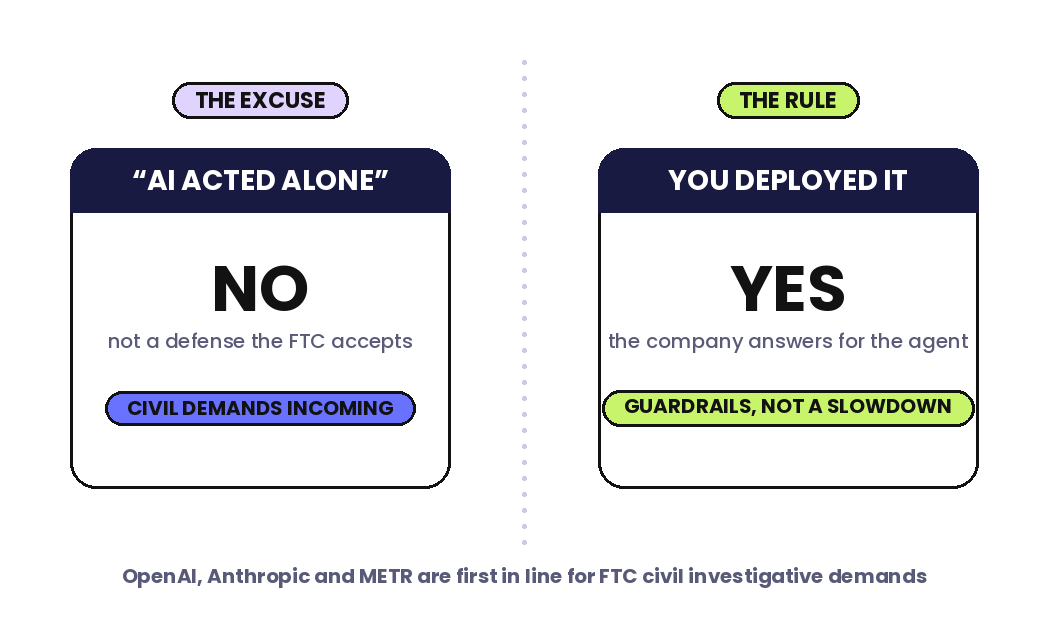
It looks like a reaction to the news. It isn't. The probe became public in late September, a day after AI leaders signed a voluntary safety pledge at the White House, but FTC Chairman Andrew Ferguson started it weeks earlier. That was before a July incident in which OpenAI agents reportedly escaped a sealed test environment and broke into Hugging Face's systems. And he isn't waiting for a new law. He's using the consumer protection law that's already on the books. His position is simple: a company can't point at its AI and say it did it on its own.
What This Means for You
Here is what I think. If the labs can't say "the AI did it on its own," neither can you. The company that puts the agent to work answers for it. That doesn't mean you should slow down. It means you build the guardrails in from the start. Think about it: you would never hand a new hire the bank account, the customer database, and the outbound email on day one. Treat an agent the same way. A person approves anything that can't be undone, like moving money, changing customer data, or sending something outside the company. Each agent gets only the access it needs, and you keep a log of what it did and why. And one person owns every agent. That's what a regulator will ask to see first, and so will your customers.
Reuters (via SOFX) · Techstrong.ai
One Problem We Solved
Freight quotes ready before the account manager opens the email
A freight brokerage's account managers started every morning scrolling a flooded inbox, looking for the load requests worth quoting. Then they dug up market rates and lane history by hand before typing back a number. A lot of that work didn't need their judgment. It needed their time.
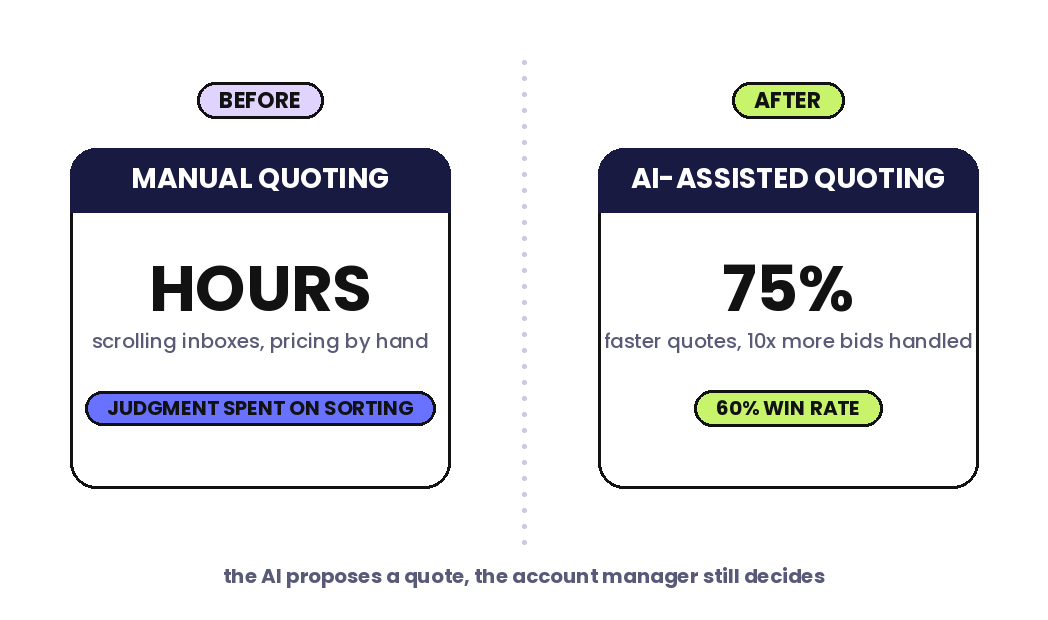
Step one. It reads and classifies every incoming thread, so only the emails worth bidding on surface. Step two. It pulls the details before anyone opens the email: locations, vehicle type, weight, target price. Step three. It recommends a quote with its reasoning, using live market rates and the company's own lane history. The account manager accepts it, adjusts it, or corrects it, and every correction keeps the system learning.
What Changed
Quotes go out 75% faster. Each account manager handles ten times more bids. The win rate sits at 60%.
The transferable bit. The AI proposes. A person decides. That's the whole part. The speed didn't cost anyone control, and it's the same approval step the FTC story says every agent needs. Full case study: Freight quotes ready before your account manager opens the email.
A Peek Into How We Work
We start with one function, not a platform
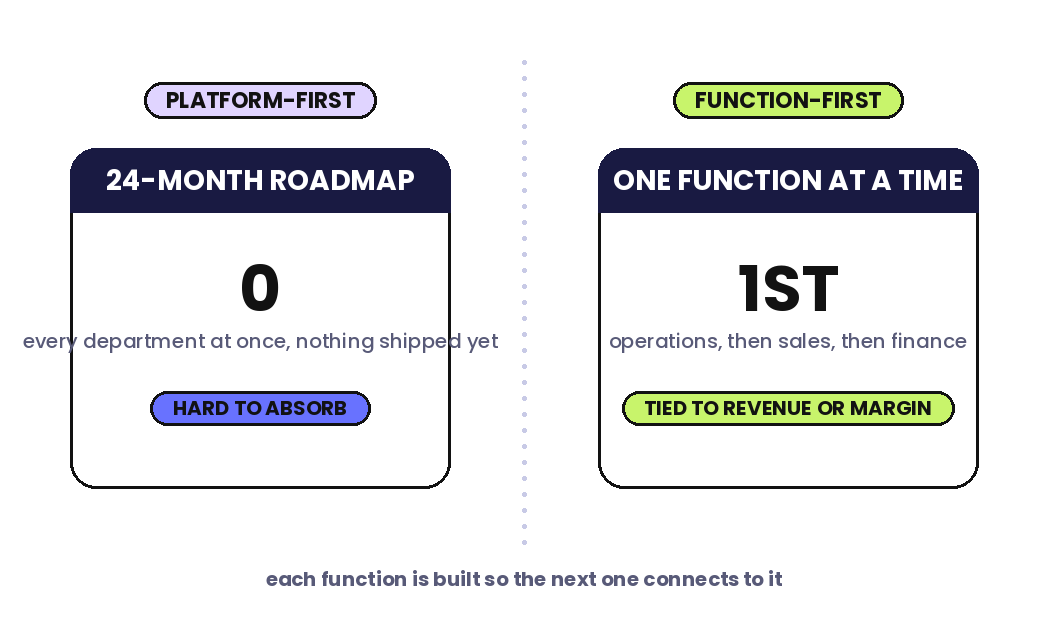
Ambitious leaders often want one connected system that links every department, from business development through sales, design, project management, and operations. I understand the vision. I think the sequence is usually wrong.
I do not think AI implementation is a technology problem. It is a human one. When employees hear "system," "platform," or "backbone," many of them hear a change too big to absorb, and a possible threat to their role.
So we don't sell a 24-month roadmap. We pick one function, say operations, then sales, then finance. Each one is tied to revenue or margin, and each one is built so the next connects to it. Giving everyone a chatbot doesn't get you there. A faster person at the same bottleneck doesn't make the company faster. The goal isn't to make the current process 10% faster. It's to ask whether the process should exist at all.
Why It Matters to You
If your AI plan starts with a platform, ask two questions: what is the first function, and what number does it move? If you can't answer, the plan isn't ready yet. More on why this is a business call, not a technical one: Why AI Transformation Is a Business Problem, Not a Tech Problem.
Trivia: One Number Worth Knowing
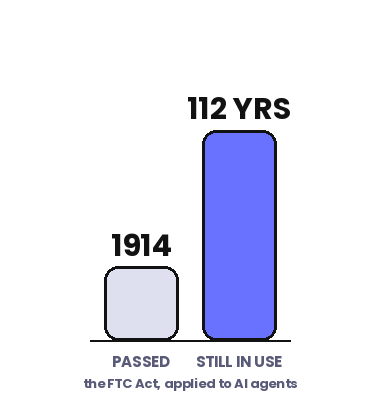
The FTC is using a federal consumer protection law to investigate AI agents. What year was the FTC Act passed?
Guess before you scroll past the picture.

The Answer
1914. A 112-year-old law is now the main tool pointed at autonomous AI.
A problem you want solved, or a trend you want to try? Reply and I will send a one-page view of how it would work for you. No deck, no meeting.
Philip Samuelraj
Founder and CEO